The problem
AI can interpret. Software must decide what can execute.
Businesses describe operations in prose: records to track, people and resources to connect, states to move through and rules that must hold. Traditional delivery translates this manually into data models, workflows, forms and business rules.
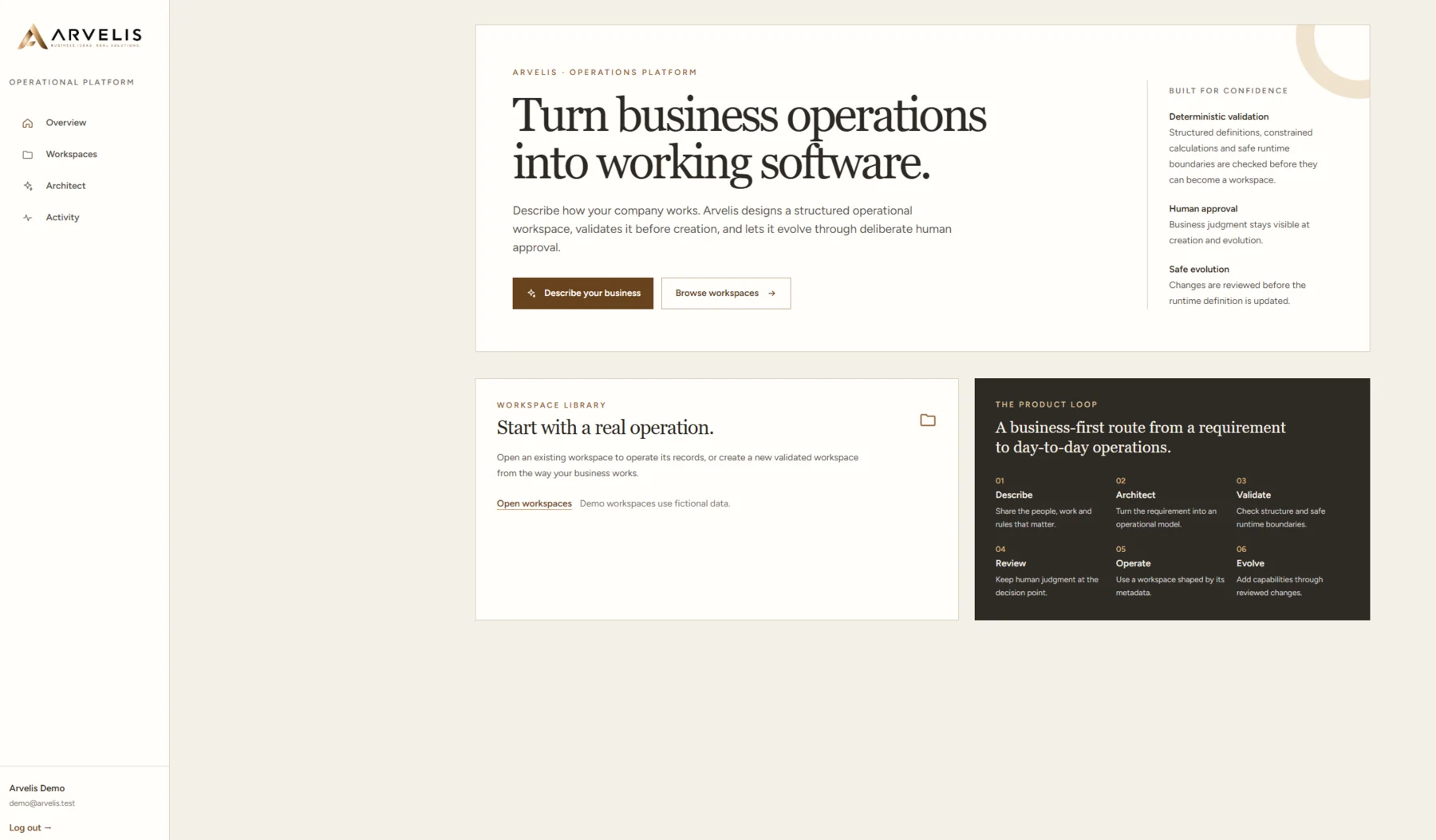
Arvelis explores a narrower architecture. Unconstrained AI code generation can produce plausible output with invalid references, unsupported assumptions or incorrect business semantics. Here, AI interprets; deterministic software decides what can execute; people decide whether the result is meaningful.
Architecture
A controlled path from requirement to runtime.
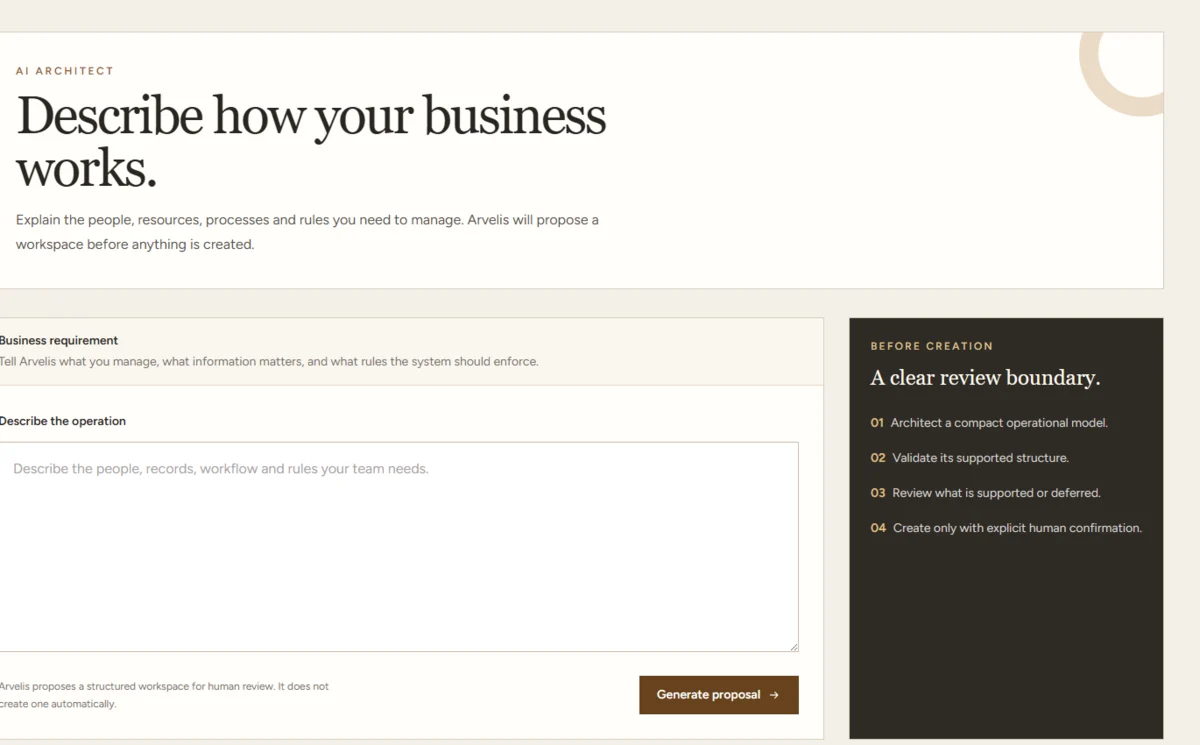
The Architect proposes a strict structured candidate. The validator checks supported contracts before anything can run. A human then reviews business fidelity before creation. Existing workspaces follow the same boundary through a separately validated patch flow.

Why not just generate an app?
Probabilistic output, constrained execution.
Untrusted structured input
AI output is checked as input, never granted executable authority. Arvelis runs no generated PHP, JavaScript, SQL or shell commands.
One controlled repair
A failed candidate can receive at most one bounded repair. Unsupported behavior must be disclosed, not approximated into a false result.
Server-side authority
Authorization, workspace isolation, workflow transitions and temporal constraints remain enforced on the server.
Human semantic review
Deterministic validity is not semantic correctness. Creation still requires an explicit human decision.

Generic runtime
One runtime, different operational models.
Accepted WorkspaceDefinitions are interpreted by one metadata-driven runtime—not a hotel-specific, rental-specific or furniture-specific application. The same engine supports entities and typed fields, relations, records, views, workflows, calculations, automations, notifications, roles and permissions, temporal exclusions and workspace evolution.

Blind testing
When the AI was wrong.
Blind test #1 — furniture
Useful model, explicit boundary.
An unseen Bulgarian requirement produced customers, orders, materials, tasks and workflow progression. It passed with an explicit deferred capability: a true cross-record stock calculation was not fabricated because it exceeded the safe calculation contract.
Blind test #2 — equipment rental
Safely rejected.
The baseline proposal remained invalid. The deterministic validator rejected invalid workflow, relation-action and temporal approximations; no workspace was created. The test exposed missing generic temporal primitives.
The architectural lesson is deliberate: plausible AI output must not bypass an execution boundary. Rejection is useful evidence when it prevents an invalid operation from reaching a runtime.
Model quality
Better fidelity does not remove the controls.
The equipment-rental scenario was run through the same requirement, schema, validator, runtime and structured-output path. Only the model configuration changed.
Model quality improved Architect fidelity, but did not replace deterministic validation or human semantic review.
Temporal capability expansion
A real gap became a generic capability.
Rental blind testing exposed a need for domain-neutral temporal primitives. Arvelis added trusted current_date and current_datetime, typed temporal comparisons, days_between, hours_between and server-side temporal exclusion with half-open [start, end) semantics.
Back-to-back windows are valid; conflicting records are prevented on the server before persistence. Temporal conditions run when an existing automation trigger executes—there is no recurring scheduler or autonomous clock trigger in v1.
Safe workspace evolution
Change is proposed, reviewed and applied transactionally.
The evolution path protects against stale definitions and double application, preserves authorization and workspace isolation, and keeps existing records where the supported patch can do so safely.

Production QA
What production QA caught.
Automated tests are necessary, not sufficient. Direct production-path review identified a CSRF demo-entry issue, a pending production migration, APP_DEBUG exposure, a GET/POST route mismatch and a demo-provisioning mass-assignment issue.
Those findings strengthened the deployed demo path: it is public, restricted, deterministic and read-only, using fictional data while provider calls, workspace changes, record writes and workflow writes remain blocked server-side.

Engineering evidence
Inspectable boundaries and verified checks.
The suite covers validation, calculations, workflows, automations, authorization, isolation, runtime CRUD, temporal exclusion, evolution, demo restrictions and mocked generation/repair flows.
Deliberate v1 boundaries
Truthful constraints over feature theatre.
- No arbitrary generated-code execution, formula language or unrestricted dotted traversal.
- No recurring scheduler or autonomous clock triggers.
- Complex related-record mutation remains constrained.
- No independent semantic AI Reviewer; human approval remains required.